
In Alberta, Canada, there are two sister mall properties, Southcentre and Kingsway, that are about three hour drive from each other. Despite their distance, these malls share a common mission of sorts. They are all about community engagement. “It’s kind of built into our DNA,” said Bo Tarasenko, marketing manager at Oxford, which owns both malls. “The top item of our brand pyramid is community development, so just by [hosting community initiatives], we kind of achieve our marketing goals.”
The most prescient example of this engagement has to be the Russia-Ukraine war, which broke out in February 2022. As a result of that tumultuous even, and even following the initial fighting, thousands of Ukrainian families fled the war and ended up in Alberta. Which is no surprise as the region is well connected to that war-torn country. In fact, more than 9% of Albertans identify as Ukrainian, more than twice Canada’s average.
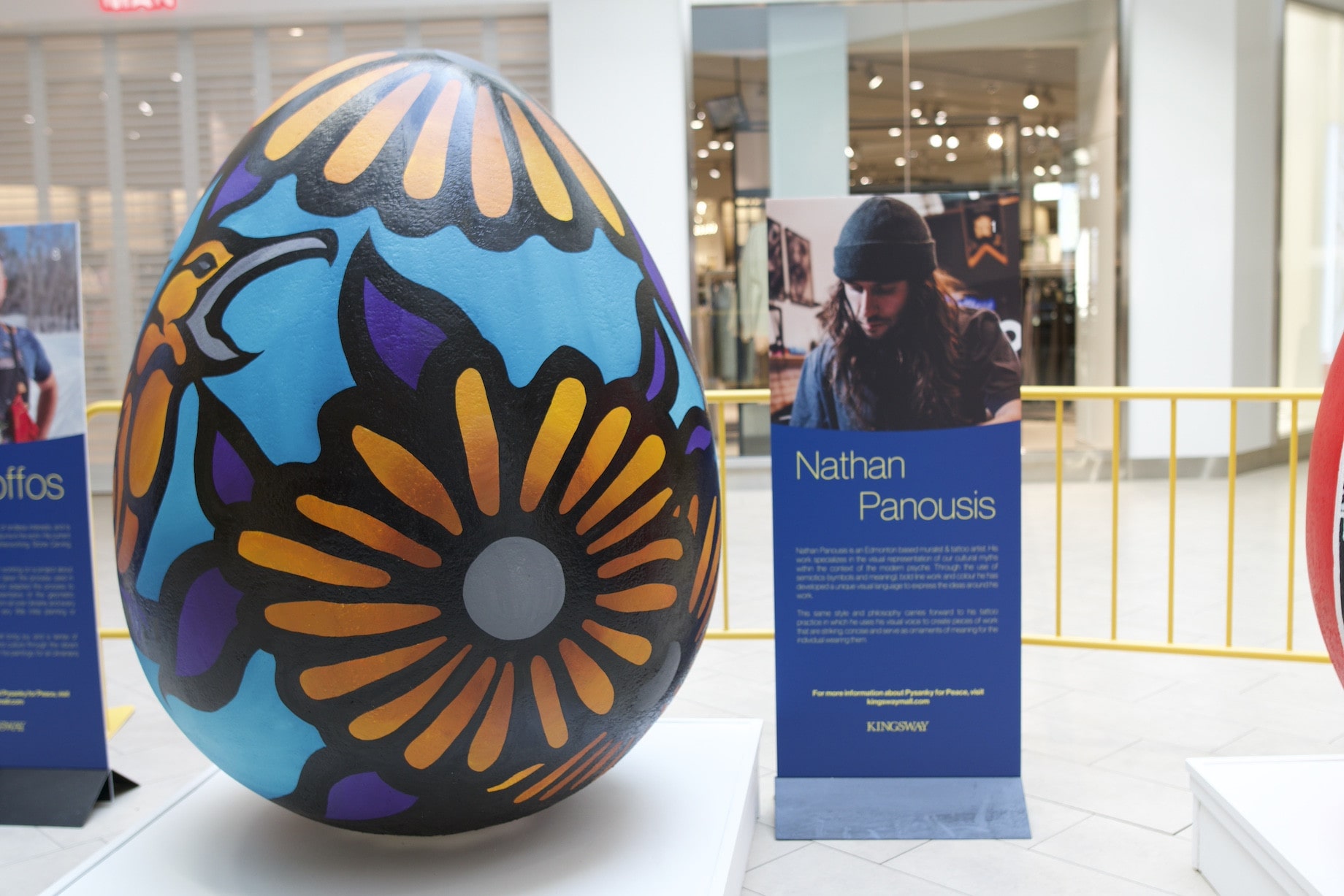
Knowing this, the marketing folks at Southcentre and Kingsway wanted to do something meaningful to help support this growing refugee community. Tarasenko explained: “Building community and making the everyday memorable are the essence of Kingsway and Southcentre brand values.” The marketing team reached out to their local Ukrainian community to better understand meaningful traditions, in hopes of finding something to make them feeling more at home. One interesting tradition they learned about was pysanky, or Easter eggs. During the Easter season, giant versions of pysanky usually appear in main streets and city squares in Ukraine, to support art and build community. But “with the war going on, the tradition would not be happening,” Tarasenko said. “We thought these familiar sights would provide comfort” for all these newcomers in a strange place.
The team “hatched” a plan to engage artists to paint six-foot eggs on-site at Southcentre and Kingsway, with the idea that they’d also auction them to aid charities that provide social services for the Ukrainian community. Tarasenk explained that an initiative like this was new for the team, so frankly, they didn’t know what to expect. Their expectations, while reasonable, were also significant: raise $12,000 from the auctions, generate 5 million unpaid media impressions, boost foot traffic by 10% and achieve a return on investment of 250%, including unpaid media, in-kind donations and auction funds, Tarasenko said.
Community initiatives like these aren’t just a noble pursuit; it’s also smart business. In today’s values-driven landscape, more and more people choose stores and centers that give them a positive retail customer experience and make them feel good about where they shop. According to a January 2023 ICSC survey of 1,000+ U.S. consumers, 59% of them said they will be more aware of company/brand values and try to buy more from businesses they feel are socially and/or environmentally responsible. “There’s a feeling of closeness and connection when people support a mission together,” said Josh Jacobson, CEO of Next Stage, a consulting company that helps nonprofits and businesses develop partnerships and collaborations.
Proving Jacobson’s statement, both Kingsway and Southcentre overwhelmingly surpassed their goals. Alongside the $11,207 raised by the pysanky auction, an additional $115,000 of support poured in to help the Ukrainian refugees. The malls also generated 17.4 million unpaid media impressions, surpassing the objective by an amazing 248%. Additionally, the campaign drove a surge in foot traffic at both at Kingsway (32% increase) and Southcentre (47% increase). Overall, the initiative was an unmitigated success, aiming for a 250% ROI and reached and amazing 1,530%.
“At the end of the day, we’re a mall. We market in space,” said Tarasenko. Community service projects are great opportunity to bring people together. Alignment with well-known community partners, such as Ukrainian support services, not only engages a property’s existing audience but also can draw in new customers. Such partnerships and service opportunities can have a substantial economic impact as well as provide “good visibility if you are trying to stand out and differentiate yourself,” Jacobson added.
Many companies believe the most meaningful community service projects are those that transcend one-time efforts and stem from in-depth conversations with nonprofits that share its core values. For Peterson Cos. regional marketing director Laurie Yankowski, “The partnerships we’ve curated and nurtured over the years are so meaningful to my properties, to the partners and to me personally.” Yankowski oversees Peterson’s Gaithersburg, Maryland open-air concept destination, Rio, with shopping, dining and entertainment. “Creating meaningful partnerships is really at the core of what we do,” she said. “To utilize our property in a way that helps their goals and also enriches the experience of [customers] on our property checks all the personal and professional boxes.”
One longstanding Rio partner is Adventist HealthCare Shady Grove Medical Center. They’ve partnered on awareness campaigns from breast cancer to cardiovascular health. At the end of 2022 they were talking about mental health. “Coming out of COVID, mental health was even more at the forefront for everybody,” Yankowski said. Indeed, ICSC’s The Rise of the Gen Z Consumer report found that 53% of Gen Zers are interested in supporting brands prioritizing mental health.
There is a spot at Rio – a tree-lined enclave along a lakeside trail, tucked away from the shopping destination that has served Yankowski always referred to it as “the road less traveled.” Partners envisioned using that space as a serene escape for those in the Rio community to pause, unwind, and simply breathe. They thought of cozy seating, art swaying with the wind and a mindfulness/meditation playlist accessible via a QR code and curated by Adventist HealthCare behavioral health professionals.
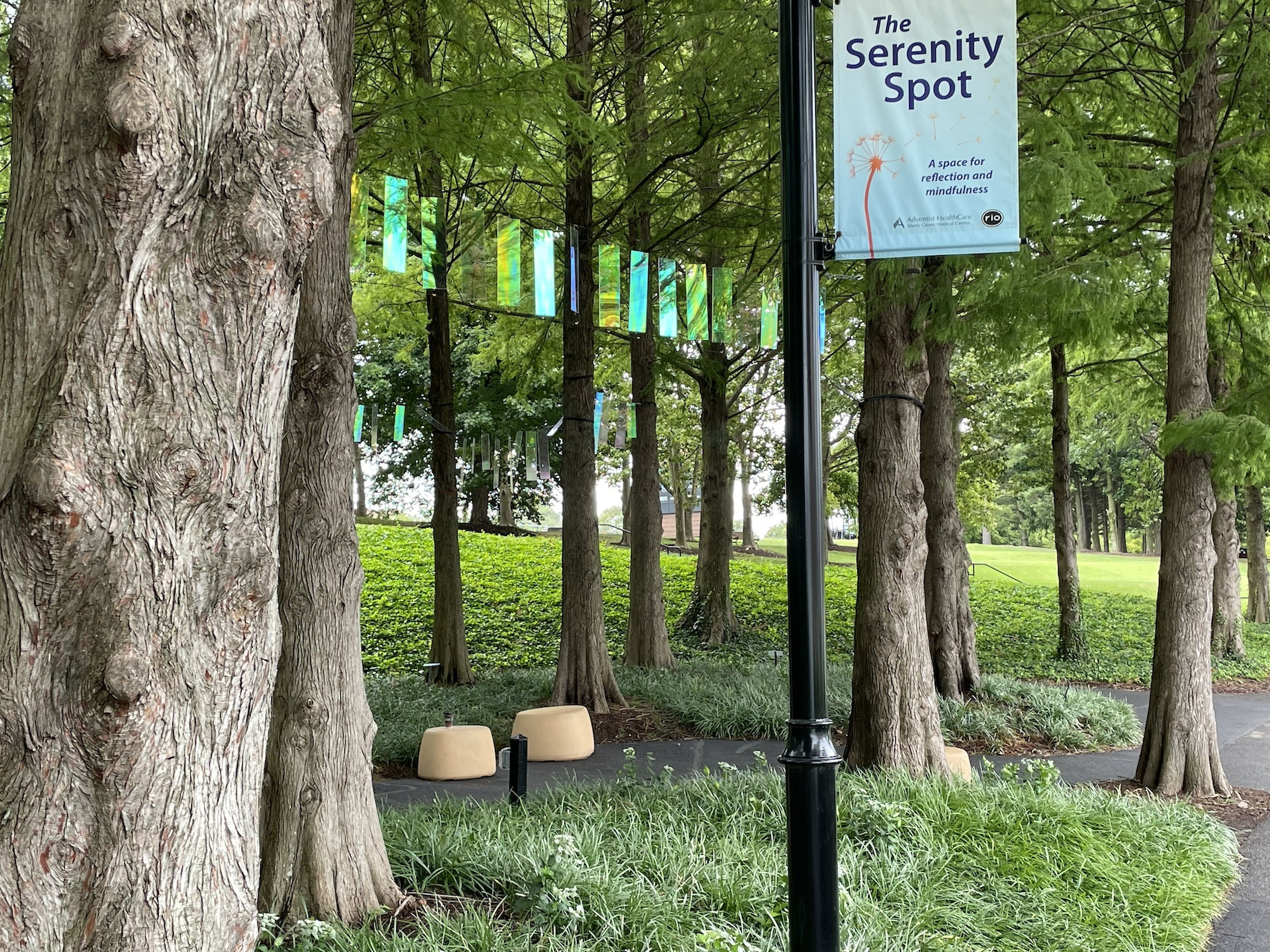
Serenity Spot unveiled on May 20, aligning with the National Alliance on Mental Illness of Montgomery County’s community walk at Rio. The timing aimed was intentional to raise awareness for NAMI’s cause and to generate funds to support its free mental health programs.
For Peterson vice president of marketing Joanna Rothermel, the potential impact of Serenity Spot is measured by the property’s traffic. “We have a little over 7 million visits each year at Rio,” she said. “We felt like we could make an impact from a mental health awareness standpoint, knowing the visitors that we get through the center and the fact that mental health is such an important issue.” Reach is also the reason Peterson and other open-air centers use their properties to raise awareness of the 988 Suicide & Crisis Lifeline. The initial seven landlords kicked off their signage initiative in the fall hoping to reach more than 250 million people.
Even when engagement isn’t or can’t be measured, there are tangible effects of serving the community. “You want to get to people’s heads, but you also want to get to their hearts,” said NewMark Merrill Cos. president and CEO Sandy Sigal. “We look at the sentiment of our customer and say: ‘Are the people happy when they’re here? How do they rate their customer experience?’ The more satisfied they are, the more frequent they come. We see it in the data, and it makes sense. You go to places that make you feel good. So yeah, it’s good business.”
A culture of giving back also makes it easier to recruit and retain talent. Research from America’s Charities found that 71% of employees say it’s imperative or very important to work where the culture supports giving and volunteering. “Employees don’t really want [giving back] to be a one-time-a-year experience but something that they can live with in the walls of your company,” Jacobson said.
Engaging with the community attracts the kinds of people who share your values, too, said Sigal. “There are plenty of property managers and there’s a lot of leasing people and a lot of other marketing people who don’t want to go through all this aggravation” of putting on community service events,” he said. Those are not the people Sigal, a philanthropist at heart, wants at his company. Indeed, Sigal’s commitment to community engagement comes from the first money he ever made. He didn’t grow up with a lot of money, he said. When he was a child, the owner of a local doughnut shop gave him day-old doughnuts to take to school and sell to his classmates.
All these campaigns help the community, but they’re necessary for a business’ survival, too. “Humans are neurologically hardwired to chase their values,” said David Allison, founder of Valuegraphics, which studies why people shop. Retail real estate properties that see themselves as lifestyle centers that cater to people’s values will see larger returns on investments, he said. “People will be 40% more engaged with things that align with their values,” he said of his company’s research findings, and companies and brands prioritizing altruism stand tall among people’s fundamental values.