
December 14, 2023
Lifestyle centers are riding a wave of momentum that shows no signs of slowing. In fact, in some markets, lifestyle centers pull traffic and tenants from underperforming malls.
“Business is extremely good, and we are getting more calls from tenants than we can handle,” said Yaromir Steiner, founder and CEO of Steiner + Associates. Sales at Steiner’s Easton Town Center are up 30% compared to 2019 with nearly full occupancy levels. For any vacancy that does open up, there might be five people who want it, Steiner said. “The two explanations are the pent-up demand for discretionary spending and experiential spending on dining and entertainment,” he said.
According to Placer.ai, U.S. open-air lifestyle centers are outperforming their peers in attracting more traffic. Year-over-year traffic at such centers increased by 2.5% in June, compared with a gain of 2% at outlet malls and a decline of 1% at indoor malls. Then in July, open-air lifestyle centers gained 1% year over year while malls declined 2.8% and outlet centers 3.3%.
Some say that one of the reasons for this growth is the small amount of new supply over the past decade. That, and tenant expansion is creating a high tide that’s raising all boats. In fact, the overall commercial real estate retail vacancy rate across the U.S. dropped to a low of 4.2% in the second quarter, according to JLL. Additionally, they reported that the net absorption in open-air centers nearly tripled to 6.4 million square feet in the second quarter and accounted for the majority of the 10.8 million square feet of total retail absorption.
Tenants Remain Active
Second-quarter data also shows sustained levels of leasing activity on a year-over-year basis. “We saw a strong surge in leasing activity in open-air centers starting in the second quarter of 2021,” said JLL Americas director of retail research James Cook. “This was driven by strong consumer spending on goods for the home, food at home and quick-service dining.” More recently, leasing activity has been driven by expansion in full-service dining, services and value apparel, he added. According to JLL, within the retail ecosystem, the top retail categories opening locations in 2023 are discount/variety at 1,917 new stores, restaurants at 1,035 and apparel a distant third at 275.
“We’re seeing leasing velocity across the board at our properties,” said Brookfield Properties executive vice president of leasing Denise Marsicano. Although there was initially pent-up demand, traffic is now settling back into a degree of normalcy. The consumer is returning with strong and steady traffic, she said. Expanding on her point that people who go out and socialize and are excited about the opportunity to shop and want to be entertained and see new food and fashion styles. “In many of our properties, consumers are returning at levels surpassing 2019 benchmarks,” added Marsicano.
Demand for Experience
Although consumers are spending less on goods, they’re still looking for experiential shopping, said Josh Poag, president and CEO of Poag Development Group. “Experience is the name of the game. That was the trend prior to COVID, and COVID just reinforced the need for experience and social interaction in the retail setting.” Poag Development owns or manages 10 lifestyle centers nationwide.
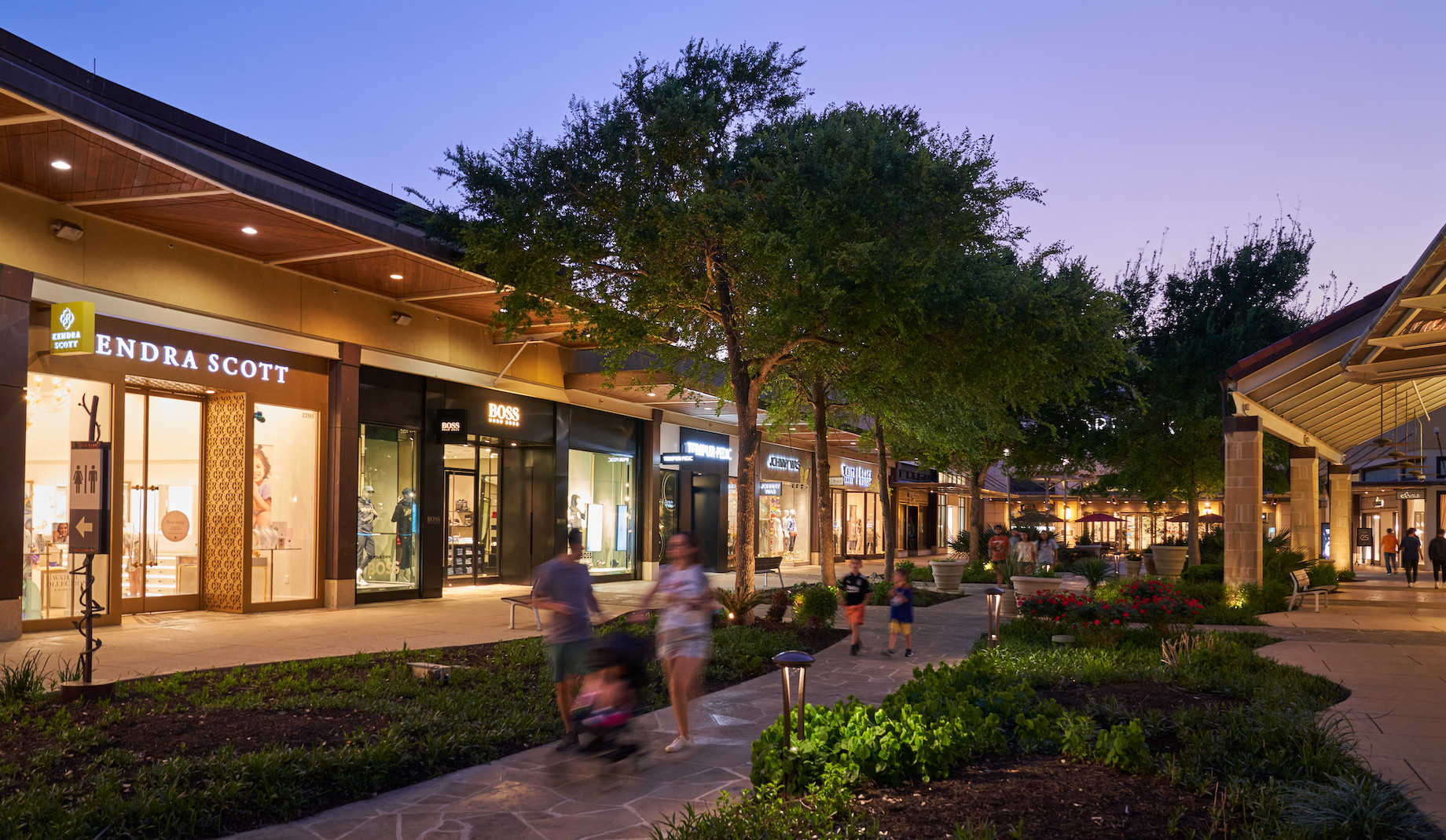
Lifestyle centers benefit from the restaurant expansion boom, as well as tenants looking to expand outside of enclosed malls. Fitness is another active leasing category bringing in an experiential component, as it can be very social, added Poag. “Not everyone wants to go out and get a cocktail. They may meet up to do yoga or play pickleball.” For example, Poag’s Shops at Perry Crossing in Plainfield, Indiana, pictured at top, features golf simulator concept X-Golf. And open-air lifestyle centers are not just a trend in the Sunbelt. There’s demand for such space in the northern states and the Midwest, too.
Outlook for New Supply
Despite tight vacancies, developers still face the standard hurdles to building new projects: cost, access to capital and anchors. According to CoStar, retail construction starts have been falling over the past year; the 11.9 million square feet of projects that started in the U.S. during the first quarter was the lowest level since 2005.
Normally, when vacancy is below 5%, developers jump in to build new projects. However, development costs are extremely high, at $300 to $500 per square foot, according to CBRE Americas retail research head Brandon Isner. “Only a few markets can achieve the rents that would justify that construction,” he said. “We might not see another traditional enclosed mall built for another 10 years, if ever, and I feel the same way about lifestyle centers.”
There is significant caution from developers and from retailers opening new stores. So much has changed with e-commerce, mobile commerce and curbside pickup. Retailers think more about innovations in commerce and appealing to that digital consumer, added CBRE Americas retail asset services managing director Mark Hunter. “We’re not in a retail real estate era anymore where a retailer will throw up a ton of stores in a market and hope that builds their brand. Now, they build their brand online or use data analytics and real estate intelligence to select precise locations to maximize trade areas,” he said.
The challenges of ground-up construction are pushing developers to look at adaptive reuse and redevelopment opportunities. “There’s real potential in the mall world for the right kind of malls to be redeveloped as lifestyle centers,” said Poag, “an opportunity to reinvigorate and add life to malls that have fallen on hard times.” In some cases, malls may need to be torn down and redeveloped as mixed-use projects with lifestyle center components. In other cases, they can be simply repositioned with more experiential anchors and more-vibrant environments.
Poag is bidding on a mall that could be potentially redeveloped to include a lifestyle component. Dillard’s and Macy’s anchor the property, and the tentative plan is to tear down roughly 250,000 square feet in the middle to create a mixed-use property; with 400 to 500 apartments and 75,000 to 100,000 square feet of new retail. “We think that 75,000 square feet of retail will be more productive than the former mall because they can do higher-volume restaurants and include more productive tenants,” said Poag.
Although there are clear challenges to new construction, Hunter sees a bright future for lifestyle centers, as well as an opportunity for the sector to continue to evolve. “Whether it is lifestyle centers or malls, I think you’ll see a continued evolution of more non-retail uses added to active space,” he said. He also expects more blurring of the merchandising-mix line between lifestyle centers and power centers. The same customer that goes into a Lululemon goes into a T.J. Maxx or Five Below, he said, so there’s more opportunity for value retailers to locate in lifestyle centers.