
Advocates of the so-called “night economy” say the Marketplaces Industry could benefit by offering more shopping, dining and services from into the evening to the wee hours. To Toronto City Councillor, Paul Ainslie, “the night economy is the same as the daytime economy; it’s just dark.” In fact, Anslie has been designated by Toronto’s mayor as the “night economy champion” for Canada’s largest metropolis.
The night economy movement is certainly gaining momentum; with cities like Vancouver, Montreal, New York, Paris, Sydney, Amsterdam and London also pushing for after-dark economic and cultural activity. They’re re-thinking how to restore foot traffic to downtown areas that can be a bit quiet after sundown, and their goals include better serving night owls and shift workers, as well as making smarter after-hours use of vacant spaces. “I’ve had conversations with people who sleep during the day and have nowhere to buy groceries when they get off from work at night,” Ainslie said.
Ainslie has focused on Toronto’s night economy since 2017. However, he was recently reappointed as the night economy booster this year by the new mayor, Olivia Chow. He’s even a part of a growing WhatsApp discussion group in which “night mayors” and “night champions” from all over the world swap ideas.
Zoning Challenges
Conflicting opinions and old rules often complicate efforts to kick-start the night economy. While some residents want quiet at night, others are looking for more concerts or public transportation, which could end up being noisy. Officials might tell a city-run museum that it’s prohibited from holding a nighttime jazz-and-cocktails event. A restaurant that clears away tables for an after-hours dance floor could be reclassified as a nightclub, which could potentially trigger tighter government restrictions. “In Toronto, you can open a nightclub from something like 7 p.m. until 1 a.m., but the rules are strict about what food you can serve,” Ainslie explained. “Basically, you might be able to buy a hot dog or finger food, but you could no longer sit down at a table and order food.’”
This past spring, Toronto wanted to determine potential updates to retail real estate licensing categories and requirements for bars, restaurants, nightclubs, and music and entertainment venues. So they surveyed residents, businesses, shift workers, and others about the city’s night economy. The research could lead to new zoning regulations, along with recommendations for supporting the night economy; while also balancing concerns about safety and noise. Ainslie said that licensing and economic development officials will release a final report on the findings this November.
Cities could create other nightlife options by revisiting their regulations and mixed use commercial property zoning practices in a similar way, said Rebecca Godfrey, senior vice president and practice lead of CBRE Tourism Consulting in Canada. A more flexible framework would make it easier for property owners to experiment with nighttime uses of their existing — and often underused — spaces. “In Shanghai and Singapore, there are a number of offices where at 5 p.m., part of the building becomes a nightclub,” she noted.
That might not work as well in North America, Godfrey said, due to regulations like noise bylaws and the cost of obtaining alcohol permits. Still, simpler options could include alcohol- and drug-free “healthy clubbing” and events like art shows, yoga and meditation groups. Or even musical performances and bars that serve mocktails and alcohol-free beer. “There’s a big focus right now on wellness tourism and wellness in general,” she said. “It creates retail experience opportunities for different types of pop-up spaces to maybe offer something to do in the evening.”
Staging nighttime cultural activities in malls or offices could spur traffic and contribute to downtown revitalization, she added. “A lot of the downtowns remain pretty empty, particularly in the evenings. The retail landlords or building owners might have something else in mind for that space over the long term, but in the meantime, they could be utilizing it and providing exposure to artists, events and performers. It’s a win-win.”
Night Owls
Advocates say cities also can support the night economy by ramping up police patrols, extending transit hours, staging cultural events, and funding marketing campaigns. As well as developing open-air concepts and streetscapes to make them safer, brighter, and more appealing. Such changes can alter the retail customer experience and potentially incentivize retailers, restaurants, and retail and mixed-use properties to stay open later.
Even without a municipal push, some businesses might rethink extending their hours after revisiting the economic impact of nighttime opportunities in their trade areas. Synergy Restaurant Consultants managing partner Danny Bendas encourages restaurateurs to look carefully at their after-hours potential. When nighttime events at stadiums, theaters, and concert halls let out, he noted, people often look to continue the fun at nearby bars and restaurants. “Universities also can be quite good,” Bendas said. “College students have varied schedules. They tend to stay up later, study, and get hungry.”
If the trade area has a sizeable number of waiters, cooks, bartenders, hotel clerks and other service workers, staying open later might be a smart move. “After getting off at 11 or midnight, restaurant people are notorious for wanting to go out to talk about their shift,” the consultant said. “Could you promote yourself as the place to come and hang out?”
Late-night restaurants do face unique challenges. Bendas said they should make sure staff stay productive if business is slow, train employees in the safest ways to deal with security threats, frequently check patrons for inebriation and refuse to serve them if they’ve drunk too much. Bendas said, “You’ve got to make sure there’s a high degree of awareness about this.” Late-night restaurants also have to find and keep managers and staff to cover those shifts.
But staying open later can be worth the effort. Bendas cited Dallas’ Bad Chicken, which operates until 11 p.m. on Fridays and Saturdays. Its owners eventually want to stay open until 2 or 3 a.m., he said. “You’re already paying rent and, generally speaking, some of the utilities, so a higher percentage of whatever you can make in a nighttime scenario flows to the bottom line.”
Night Anchors
Architecture and design can help property owners supercharge nighttime traffic and sales, said Mitra Esfandiari, an architect and partner at RDC. “Today’s consumers want more than just a place to eat and shop,” she said. “They are looking for curated, memorable experiences.”
RDC aimed to design a date night-friendly magnet in Sky Deck at Del Mar Highlands Town Center in San Diego. Completed in 2021, the multi-restaurant addition to the 30-year-old shopping center was the brainchild of former Donahue Schriber Realty Group chair and CEO Pat Donahue and the culmination of the company’s $120 million redevelopment of the property. First Washington Realty acquired Donahue Schriber, including Del Mar Highlands, last year.
For inspiration, Donahue Schriber flew some of its own people and some from RDC to Barcelona to see the city’s El Nacional culinary destination. Packed with patrons late into the evening, it boasts four bars serving an array of beers, cocktails, wines, preserves and oysters, along with four restaurants focused on Iberian Peninsula recipes. Each zone is an experience unto itself, with high-end finishes and separate seating areas, Donahue said. “I thought it was one of the coolest places I had ever been.”
Sky Deck offers 26,700 square feet of alfresco-style culinary zones on multiple levels, with a unifying “nautical industrial” aesthetic inspired by the nearby California Coast. Operators include Craft House, Kiin Extraordinary Thai, Parfait Paris, Marufuku Ramen and Urbana Mexican Gastronomy & Mixology.
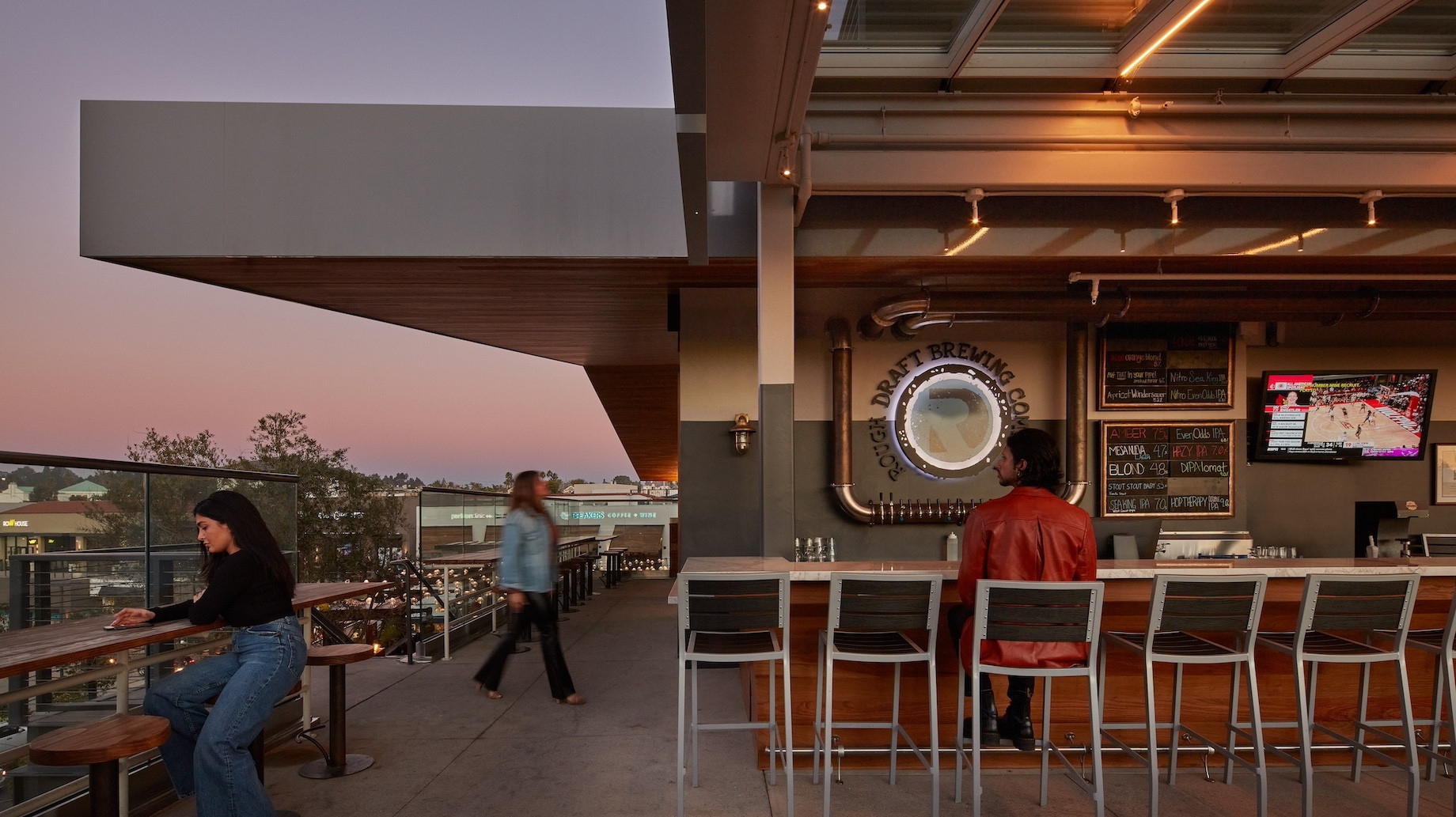
RDC tasked lighting designers with adding drama and ambience to the night experience through lanterns, firepits, string lights, indirect lighting and suspended sconces, pictured at top. Artworks and found objects echo the maritime concept, while additional elements include a central bar on the ground level with lit trees, suspended artworks and a 100-foot-long mural. The net effect of these experiences, the architect said, is to “attract visitors and keep them staying for longer.”
Indeed, Sky Deck has driven nighttime foot traffic higher. The property has achieved record-setting sales per square foot, according to Donahue. “After we opened, I would go and watch what was happening,” he said. “Sky Deck would start getting busy at about 7 p.m., while the rest of the center was winding down. By 8 p.m., our inline restaurants were quiet but Sky Deck would be packed to capacity.”
For such a rethink to work, the developer noted, the demographics have to be right. Decades of densification in Del Mar’s trade area, where the average household income has grown to more than $230,000, made it a strong fit for the night-focused addition. “None of our 60 shopping centers had anything close to the same income and education levels,” Donahue said.
“If we had put in a traditional food court with common seating, the performance would have been marginal at best,” he said. “The currency at lunch is time, getting in and out quickly. The currency at dinner is the experience.”
The night economy can bring dual benefits to those who take the right approach, Donahue concluded. “It extends your hours of operation, which is economically efficient, but it also expands your trade area because people will come farther for that experience. Taken together, those two things are a big deal.”